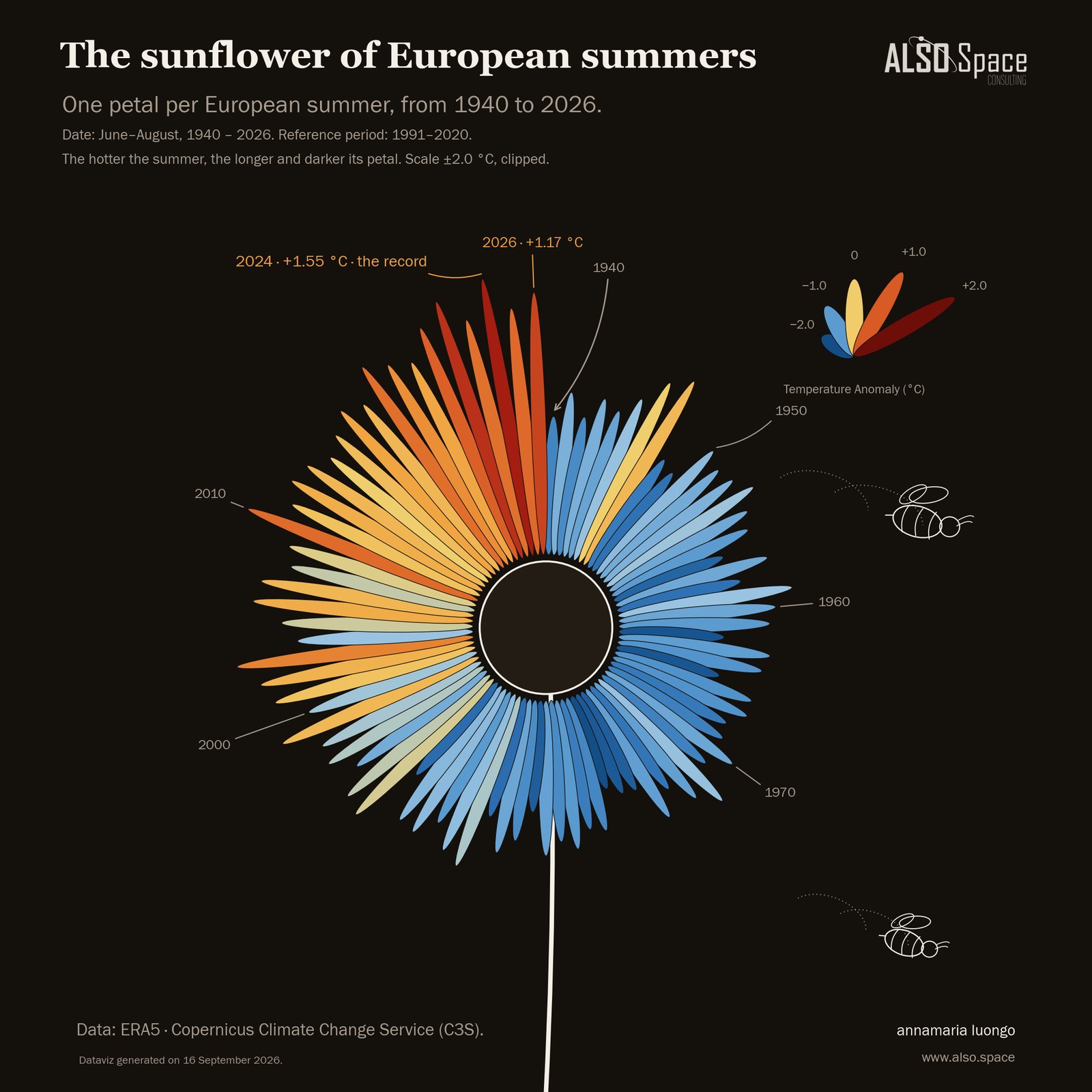
For most of the last century, European summers were cooler than they are today. Most of the warm ones came from 2010 onwards, and the summer of 2026, driven by an exceptional June, was the third warmest on record.
The sunflower of European summers has one petal for each summer since the series began, counted from June to August. The longer and darker a petal, the warmer that summer was compared with the 1991–2020 average over European land, while the short blue petals mark the cooler ones. Read clockwise from the top, the flower shows 87 summers in order, which is why a change in their pattern is visible at a glance.
In the first five decades of the series, the flower is almost entirely blue, and those petals fill its right half and most of its lower part. All but one of those summers were cooler than the average, and the only exception, 1947, was about 0.2 °C warmer. The coldest petal of all belongs to 1978, a summer which sat more than 2 °C below the average.
In the two decades which followed, warm petals became more frequent, although 14 of the 20 summers remained below the average. In 2003, the summer of the western European heatwave, the anomaly went beyond +0.5 °C for the first time on record.
The change is concentrated in the summers since 2010. Of those 17 summers, 16 were warmer than the average, and the only exception, 2014, was 0.01 °C below it. As a result, 9 of the 10 warmest European summers on record belong to this period, with 2003 as the only earlier entry. In the sunflower, the summers from 2018 to 2026 form a run of long petals at the top of the flower, just before the first petal of the series.
In the seven most recent summers, European land was on average about 1 °C warmer than in the reference period, and about 2 °C warmer than in the first three decades of the series. Only three summers have exceeded the average by more than 1 °C, and all three fall within the last five years.
With an anomaly of +1.17 °C, the summer of 2026 was the third warmest in Europe on record, behind 2024 and 2022, the two other summers above 1 °C. June brought nearly half of its heat, as the second-warmest June on record. July was milder, while August returned above 1 °C and ranked fourth among all Augusts. An average of this kind, taken over a whole continent and three months, also smooths out the days and the regions in which the heat went much further above the norm.
The meadow applies the same idea to whole years and to nine regions: the globe, Europe, five continents, and the two polar bands, the Arctic and the Antarctic. In six of the nine regions, the warmest year on record is 2024, while the Arctic, Oceania, and the Antarctic peaked in 2016, 2019, and 2025. From January to August this year, all nine regions were warmer than the average, with Asia and the Antarctic at the top.
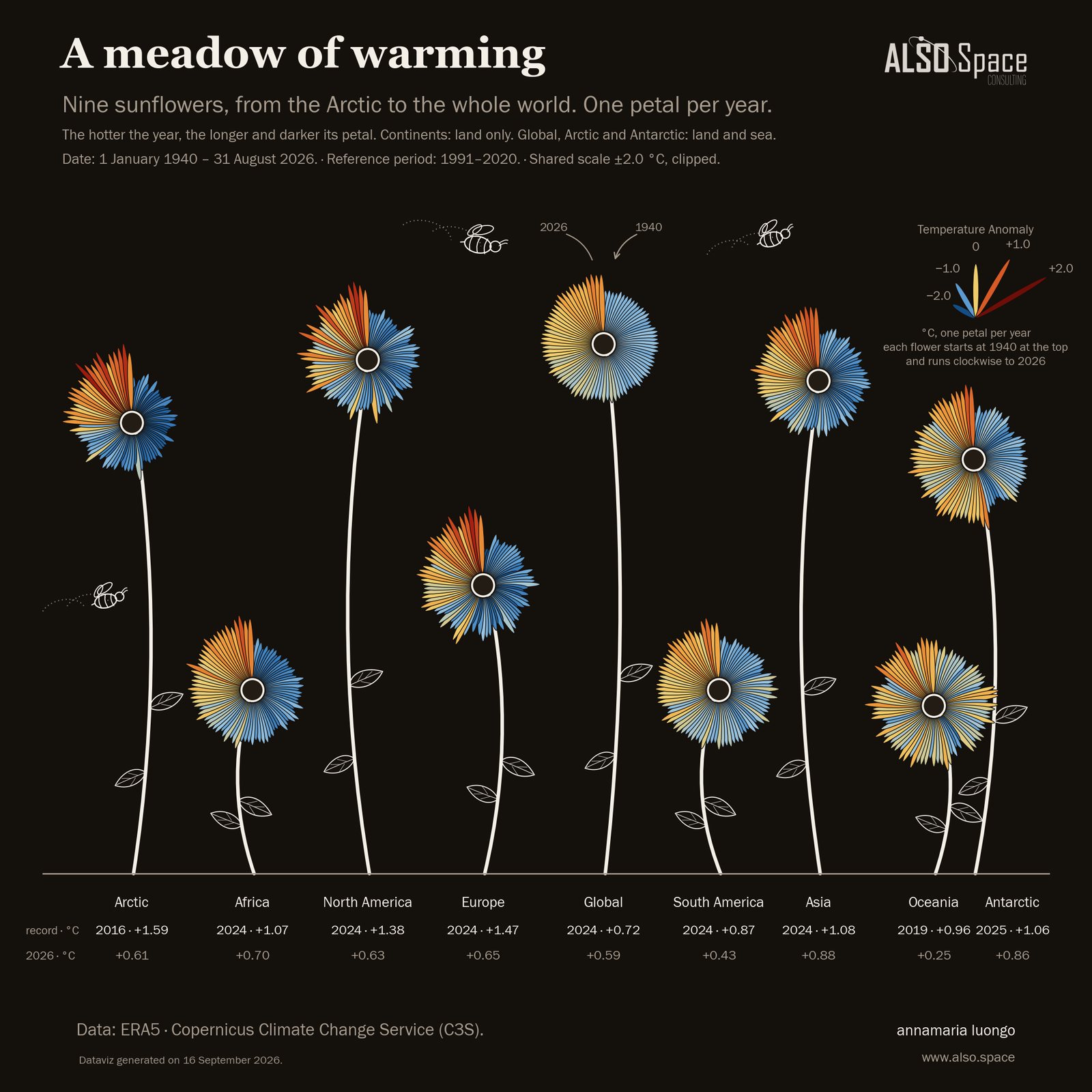
The summer months tell a similar story. In June, July, and August this year, the globe as a whole was level with 2024 as the warmest on record, while the Arctic, Africa, and Asia had their warmest summer months since the series began. Europe, third in its own ranking, stands out for the pace of its change, which since 1980 has been about 0.5 °C per decade, more than 2.5 times the global summer rate.
ERA5, the climate reanalysis produced by the Copernicus Climate Change Service (C3S) at the European Centre for Medium-Range Weather Forecasts (ECMWF), describes the weather of the whole planet, hour by hour, from 1940 to the present. Such a long and consistent record allows each new summer to be compared with every summer before it, on the same basis.
Source: ERA5 monthly means, Copernicus Climate Change Service at ECMWF, to August 2026; anomalies against 1991–2020. Europe and the globe as in the C3S monthly bulletins; the other regions are my calculation with the same rules.