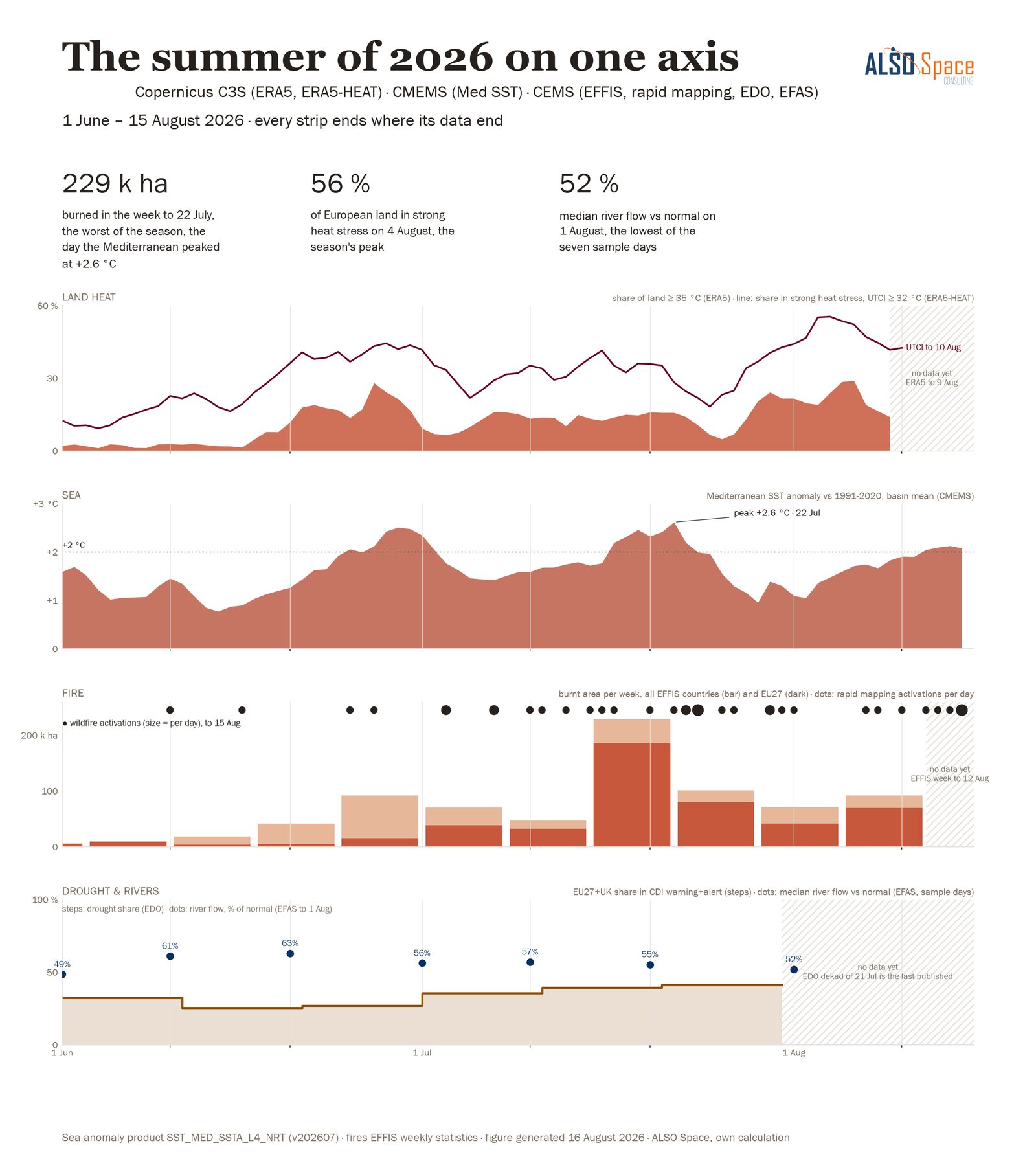
The summer of 2026 was often described as a chain: the heat dried the land, and the dry land burned. Measured country by country, the first link holds and the second does not.
In the story of the summer, heat, drought, and fire followed one another as parts of a single event. Each link of that chain can be measured with Copernicus services, country by country and against each country's own normal, so I measured them for June and July, the two months for which every service had published its figures. The result differs from one country to the next.
Across Europe, the countries with more days above 35 °C in June and July tended to burn more above their own normal. Spain, Italy, and Germany burned more than twice their usual area for the period, and Portugal almost twice. The link holds for the number of hot days, although not for heat stress, since the places with the highest heat stress were not the places which burned most.
The second link does not hold. Soil drought, measured with the Combined Drought Indicator of the European Drought Observatory (EDO), showed no positive relation with fire, however it was measured. Spain burned about 187,000 hectares, more than six times its normal area for the period, on soils wetter than usual, and Ireland burned more than in any June and July since 2006, on wet soils too.
In Hungary, the drought was severe while the fire was limited: 86% of the territory was in drought and the rivers ran at 41% of their normal flow, yet little burned, although June and July together were the fourth warmest there since 1985. Greece, for its part, had soils wetter than normal and less fire than average over the same two months.
Weeks with at least two days above 35 °C on soils in drought were rare in June and July: five in all, three in France and one each in Hungary and Slovakia. France's three hot and dry weeks burned about 5,800 hectares together. In the week to 22 July, one week after its last hot week, France burned about 42,000 hectares, 108 times its normal for that week, on very dry soils. In the same week, Spain burned more than twice as much, about 91,000 hectares, which was 15 times its normal, with heat and no drought.
The largest share of the burnt area, 43%, burned in hot weeks on soils which were not dry. Over June and July as a whole, France was also the only country in which heat, drought, low rivers, and fire all ranked among the three most extreme of their own records, with its rivers at their lowest flow on record for the period. France is therefore the one place in which the chain of heat, drought, and fire holds from start to end.
The Mediterranean Sea warmed about three days after the land. Its surface temperature anomaly, from the Copernicus Marine Service, peaked at +2.6 °C on 22 July, the last day of the worst week of fire, and inside the busiest seven days of June and July for the rapid mapping of the Copernicus Emergency Management Service (CEMS), with eight activations from 20 to 26 July. Both followed the same heat in the atmosphere, and the warm sea did not start the fires.
These are correlations between countries and weeks, and they are not attributions. Wind, ignitions, and land management also decide where a fire starts and spreads, and they are not part of the analysis. The analysis window closed on 31 July, before the drought and river figures for August were published.
Taken one at a time, the Copernicus services each describe one part of the summer: the Copernicus Climate Change Service (C3S) the heat, the European Forest Fire Information System (EFFIS) the burnt area, EDO the soils, and the Copernicus Marine Service the sea. Read together, they make it possible to test the story of a summer against measurements.
Source: ERA5 and ERA5-HEAT, Copernicus Climate Change Service; Mediterranean Sea surface temperature, Copernicus Marine Service; EFFIS, EDO, EFAS, and rapid mapping, Copernicus Emergency Management Service, with the EFFIS figures published on 16 August 2026; 1 June to 31 July 2026, each country against its own normal. My calculation.