We care about a changing climate and about the people who live with its consequences, and we believe in carrying knowledge to them together.
The evidence of climate change has never been more complete, and the data are open to anyone who looks for them. The archive of the Copernicus Climate Change Service holds a long-term temperature record, and the highest full year so far is 2024, when the global surface air temperature reached 0.72°C above the reference period.
However, a number in an archive changes nothing until someone uses it. In practice, scientific communication often remains a niche, written by experts for other experts, and an accurate figure can stay invisible to the mayor or the family who needs it most. Uptake is the missing step between knowledge and impact, and impact appears when behaviours change over the years, which takes time, work, and strategy.
Meanwhile, scientists write for other scientists, and journalists race against the next deadline. Artists follow what moves them, and each of these communities can spend a whole career inside its own hive.
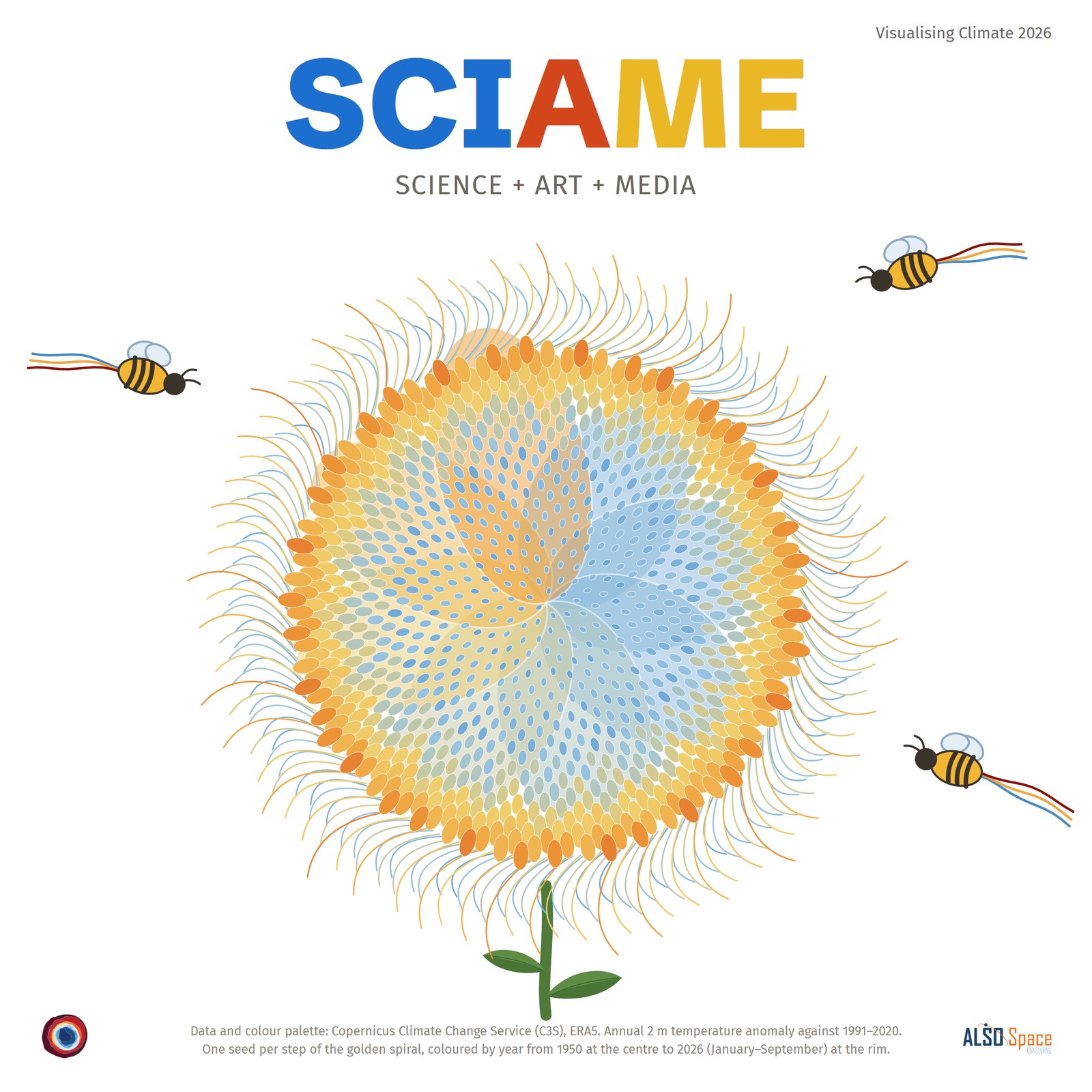
In August 2026, I published two figures which tried to cross those borders with a very old shape, a sunflower in which every year became a petal and a meadow in which every region of the world became a flower. To my surprise, they went viral, although the idea behind them still had no name. The name arrived three months later at the Visualising Climate Conference in Bologna, when Anna Lombardi introduced the metaphor of cross-pollination and I immediately thought of my sunflowers. The room was full of scientists, journalists, designers, and artists who had often worked alone in this way for years, and on that day they looked around and found each other.
This way of working now has a name, SCIAME, which joins SCIence, Art, and MEdia. In Italian the word means swarm, the image of many small journeys adding up to one living movement.
A swarm starts from the data, and every mark in a visualisation must be able to answer one simple question about what it measures. A swarm speaks three languages, as science brings the evidence, media bring the question people are asking, and art brings the reason to stop and look.
A swarm travels to the newsroom, the laboratory, and the studio of someone else and comes back with something new. A swarm shares the method, the mistake, and the credit, as every idea which passes to someone else can grow into something its author never imagined.
A swarm speaks to people, as a number becomes a story on the day when someone recognises their own street, their own summer, and their own children in it. A swarm stays open, naming those who taught it and leaving room for whoever wants to join, whatever their background and wherever they start.
The video I created comes with this manifesto and tells the same story. Bees gather from every continent and build three flowers, one for science, one for media, and one for art. As the bees move between them, the three flowers fade into the background and a new one opens with a shape none of them had on its own.
Somewhere today, a scientist holds a number which could change a decision, a journalist is looking for the story behind it, and an artist is waiting for a reason to draw it. Any one of us can be the bee which brings them together.
SCIAME is the essence of the way I make data visualisation, and I invite you to make it yours in your next chart or your next talk. Take one idea from a field which is not yours and carry it across, because the meadow we all share blooms one journey at a time.
Source: ERA5, Copernicus Climate Change Service, global surface air temperature anomaly against 1991–2020; Visualising Climate 2026, Bologna, 4–6 November 2026