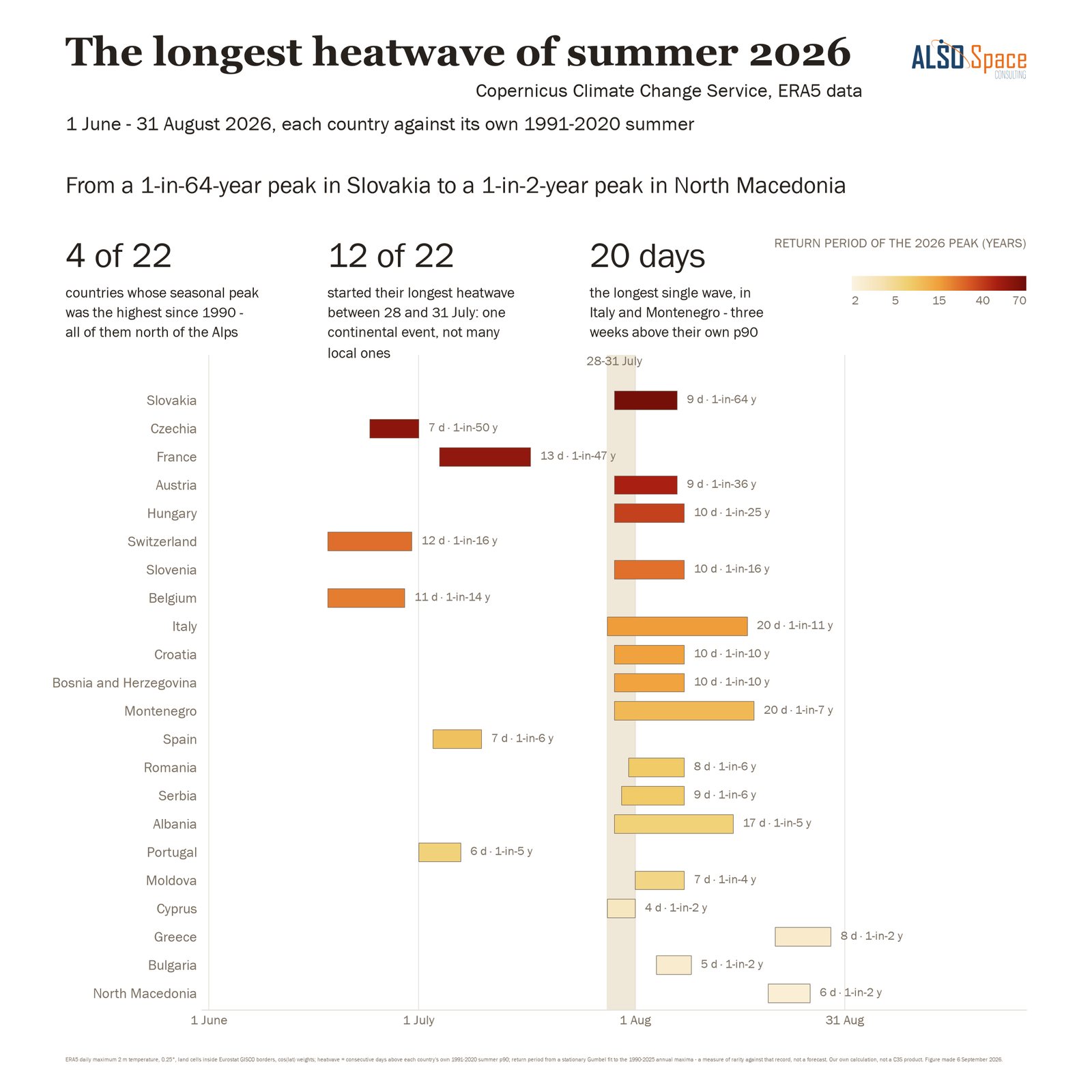
The same summer was a 1-in-64-year event in Slovakia and an ordinary one in North Macedonia. Measured against each country's own summers, the rarest peaks were in central Europe and France.
A national average of 34 °C on the hottest day of the summer is ordinary in Greece and exceptional in Austria. For this reason, I measured the summer of 2026 in 22 European countries against each country's own summers, in two ways. The first is the hottest day of the season, averaged over the whole country, and how often a peak of that height comes back. The second is the longest run of days above the temperature which each country exceeds on 10% of its summer days.
Four countries recorded their highest summer peak since 1990: Slovakia, Czechia, France, and Austria. In Slovakia, judging by the summers since 1990, a peak of that height comes back about once in 64 years. In Czechia, France, and Austria, the figure lies between once in 37 and once in 50 years.
In the south-east of Europe, the pattern was the opposite. On its hottest day, Greece reached a national average of 34.4 °C, higher than the 32.7 °C of Austria, yet for Greece it was only the 19th highest peak since 1990, while for Austria it was the highest. At the end of the ranking, North Macedonia, Bulgaria, and Greece had peaks which come back about every two years.
In the south, the summer was defined by its length. In 12 of the 22 countries, this summer's heatwave ranks higher for its duration than for its peak, and the peak ranks higher in seven, including Slovakia, Czechia, and Austria. Italy and Montenegro spent 20 consecutive days above their own threshold for a hot day, and Albania 17, although none of the three set a new peak.
The strongest result of the analysis concerns the timing of the heat. Between 28 and 31 July, 12 of the 22 countries entered the longest heatwave of their summer, from Italy and Cyprus in the south to Hungary, Serbia, and Romania in the east. The figure shows them as a vertical band of bars which start within four days of one another, although whether they formed one connected heatwave was not measured.
In June, the longest heatwave of the summer began in only three countries, Czechia, Switzerland, and Belgium, which is about the same share as in an ordinary summer since 1990, although in Switzerland and Belgium it was the longest since 1990. The heat of late June affected a great many people at once, although in most countries it was not the heatwave which lasted.
A return period describes how unusual a peak was compared with the summers since 1990, and it is not a forecast. In a warming climate, peaks such as these come back more often than the past suggests, so the figures above measure how unusual the peaks were compared with the recent past. In addition, the count leaves out most of northern Europe, from Germany and Poland to the United Kingdom and the Nordic countries, as well as Luxembourg and Malta, and the northern side of the picture is therefore, if anything, understated.
ERA5, the climate reanalysis of the Copernicus Climate Change Service (C3S), provides daily temperature for every country on the same grid, from 1940 to the present. With it, a heatwave in Slovakia and one in North Macedonia can be compared with the same method, each against the summers its own population is used to.
Source: ERA5 daily maximum temperature, Copernicus Climate Change Service, 1 June to 31 August 2026; national averages over land, each country against its own 1991–2020 summers, return periods from the peaks of 1990–2025. My calculation.